Showing posts with label Spelling. Show all posts

Saturday, August 8, 2015

What About Spelling?


As we sit around the evaluation table with homeschooling families this summer, great questions surface. This week, "What about spelling?"


A common question with several appropriate 
answers dependent upon 
educational philosophy, age, ability, and learning style.

There are many ways to teach spelling
  • Purchase a traditional, grade-leveled spelling curriculum. 
This is the first answer which comes to mind for most parents. Easy-peasy; buy the curriculum. Done. Works well for some folks.

  • Choose high-interest or frequently used words.
This method takes a bit more work, but is pleasantly effective. Works well for active learners and learners with interests which saturate their days. Words of interest often return the greatest reward. There is a purpose to learn.

For example, live with a fisherman? Consider words of interest: bait, tackle, license, trout, shrimp, brackish, hook, sinker, shore, catch, freshwater, captain, salmon, carp, permit, marsh, or wade.

Sometimes we have used objects of interest to learn spelling. One of our most unusual items have been acorns and cereal. Stickers and foam letters make great teaching tools as well.

Starting with the most frequently used words? Check out these lists:

Learning Resources posted and ranked 300 words

  • Play a game.
My children always enjoy a good game. Games add spark to learning. When there is a less-than-favorite subject to learn, we try a game. If we don't own a game to teach a particular subject, I make one. 
  • Compile a "I want to learn these!" list.
Where there is intrinsic motivation, retention is not far behind. Whether learning a new skill or reading a book with intriguing vocabulary there are likely words the child wants to know. Use the words of interest to compile a "I want to learn these!" list, place it in a notebook, and whittle away at it each week.
  • Tackle commonly misspelled words.
Compare lists at a given level to find the most often cited misspelled words.

Elementary School
National Curriculum Associates complied this list from children's writings, grades three through eight.

ABCTeach published multiple lists

Mrs. Martin's 100 most commonly misspelled words

Your Dictionary lists

Horicon school district language arts helps

Spelling-Words-Well multiple grade lists

Fry's Instant Word List

Middle School and Above
Info Please offers their compilation

John Burroughs Middle School offers spelling and vocabulary lists

Kenneth Odle's most commonly misspelled middle school words

High School and Beyond
Capital Community College list from Student's Book of College English by David Skwire and Harvey S. Wiener. 6th ed. MacMillan: New York. 1992

Oxford Dictionaries common misspellings

  • Use a combination of several above. 
Though cliche, it is often true of learning: variety is the spice of life. Educators have used a combination of the above possibilities and been highly successful at teaching children this often dreaded and difficult skill. Use what works and spice up learning during the dry seasons.

Spelling comes in different, very effective packages. There is not a tried-and-true method. Each child receives, stores, and retrieves information differently, especially with spelling. Hence a individualized path is often necessary in order to produce the greatest retention.


Wednesday, August 5, 2015

Life and Learning Collide: Natural Spelling and Handwriting


Thank you notes, a great way to learn writing, practice penmanship and build relationships, naturally.

I don't intend to ruffle feathers. Schooling methods are as unique as the children who are being taught, in homes or schools. I am not disputing methods or means. I want to encourage moms, mom
s who are teaching without realizing the impact they are having, wondering if they are "doing enough".

Celebrating several birthdays lately, I am reminded of the great lessons and practice woven into writing a thank you note, and it is natural, engaging, important, with real-life benefit.

I am also reminded of the workbooks I experienced as a child. Prompts to which I could not relate; some so silly I felt as if my intelligence was being challenged!

Which would I rather write?

Of course, the one that mattered to me personally.

Reflecting on our twenty-one years of home education, I find the same has been true for my children.

They want to write what matters.

So, when a new ball cap was unwrapped for a birthday, a new writing opportunity presented:


Grandma gives you a baseball bat for your birthday. Write a thank you letter to Grandma.


Writing with purpose, an intrinsic desire. Not in response to a made up prompt.  

So moms, next time you child celebrates a birthday or holiday and wants to write a thank you out of gratitude, embrace the moment. Walk alongside your child in his or her natural response to life. Answer questions about spelling and punctuation. Write hard words on paper for them to copy onto their thank you card. Find an envelope and talk about how to write an address. The intrinsic motivation to thank a grandparent (or other significant person) will drive the learning. Why? It's important to the child. Couldn't ask for a more natural, productive lesson...and grandma will be thrilled!

Use life, what is natural to learn life skills.

Thank you and letter writing is not the only way to learn writing and spelling. Every child has an interest, a pathway on which learning become enjoyable, natural, essentially easier, hopefully without tears and frustration. Often these ideas are spontaneous and child-initiated. 


Not long ago one of our children asked if she could copy the text from a favorite animal book checked out from the library. We talked about plagiarism. She simply wanted to write the text so she could remember the words after she returned the book. Her thoughts reminded me of how writing, grammar, and spelling were learned by great leaders in history. Many of those leaders became extraordinary writers. My daughter copied the entire book. It later became part of a project she initiated. Writing, spelling, naturally. 

I am not saying we have never used repetitive writing of a word to learn its spelling. We have. The point is, we use whatever is appropriate for a particular child, at a particular time. 


One day celery prints took a twist and we decided to list "C" words. It was spontaneous and FUN!


Children with a creative bent can naturally integrate writing into their art. One of our children decided to make "fancy" thanksgiving cards with a creative greeting tucked inside. 

Taking learning outside, in a different environment is helpful for mom and children!

Writing and illustrating outside!

A "new" outside patio set makes a great place to write.


Once inside, tummies rumbling, cookies and crackers with letters give spelling a boost. 


Sometimes I make games for my children. Time consuming, yes. However, the results have been astounding for the child who needed that method. And, with the intrinsic interest and love for games, often the child will ask to pull the game out again for review. 


The spelling and writing I remember was tedious, rarely applicable to life. It was laborious, especially for me, a non-phonetic reader due to processing challenges. I was the child my third grade teacher said would never read. However, my parents (mom especially) incorporated learning into life: writing recipes, grocery lists, making "books", and playing restaurant. Most of all I remember my parents partnering with me, walking alongside to help and process my ideas. 

Moms, you can help your child learn writing, grammar and spelling, naturally, in ways that are fun. These activities also pack in the highest retention, meaning your children will remember what they learned. Ponder the happenings in your home. How many of the activities are you passing off as play or something that needs to get done (like an email) that actually teach great lessons in language arts? 

*The information in this blog post is not intended as legal or educational advice. It is simply a journal of what worked for us. Parents are responsible to oversee their child's home education. 


Wednesday, November 26, 2014

Fall Spelling Fun


Have acorns? Spell!


This week my daughter had a wonderful impromptu idea.

"Remember those acorns I collected--all 224 of them? I used them to spell words!"

Brilliant idea. 


I walked to the kitchen to see her masterpieces.

Indeed creative. Indeed reinforcing learning.

After discussion, it was determined that gluing the words to cardboard would make festive Thanksgiving decorations. Just add a bow hanger.

And so goes the day when acorns become spelling practice. 

(Just one day after the bursting  baggie of acorns were the place value and counting lesson. Simple, available, and intriguing equal many days and ways of learning.)

Tuesday, December 3, 2013

Spelling and Hair Cuts

"Mom, can I go with you to your haircut?"

Sure. Impromptu date with one of my littles. Who could pass up such an opportunity?

On the car ride to the salon, the little discovered she had a small tablet and pencil in her "purse". She pulled it out and exclaimed, "Mom, I can do my spelling! I will just look for words."

Fabulous!

The drive went unusually fast, probably because we were busy looking for words, spelling.

We arrived and parked.

My daughter eagerly carried her tablet into the salon, dreaming aloud of the words she would find.

As I took the salon chair and greeted my stylist, my heart warmed as I noticed my daughter walking, pausing at each station to write.

"H-A-I-R!"

"C-U-R-L!"

My stylist watched my daughter intently, thoughtfully, perhaps a bit too intently as I watched ALOT of hair fall to the ground.


He finished cutting my hair. I noticed the cut was a bit shorter than usual.

Short hair. Four pages of words.Natural spelling. A testimony to the unique opportunities home education provides. Nothing beats a child excited about learning, smiling at her accomplishments. Those moments are valuable. The hair, it will grow back.


Wednesday, June 12, 2013

Spelling Cereal


Two weeks after an incredible "buy one get one free" sale and an impromptu spelling lesson with the cereal purchased at the sale, Dad was home, watching the young ones while I headed off to an appointment. When Dad asked what each child would like for breakfast, the four year old promptly asked, "Dad, could I have some of that spelling cereal?"

Dad wasn't quite sure whether spelling cereal was a breakfast choice or one of our educational games.  Upon further questioning, the four year old exhorted, "Dad, just open the pantry."

He did and quickly found out that spelling cereal was indeed a breakfast choice. It was letter-shaped cereal we had used for spelling a few days prior.

When I arrived home, my husband quipped, "Will you quit having so much fun with the kids!" I snickered.

Monday, April 15, 2013

Motivation Sparks Learning

A day of discovery and interest-led learning. Better than anything I had planned. Better yet, it will be remembered.

The current interests were ignited by our friends' recent return visit from their work in Kenya. My children heard their stories, viewed their safari pictures and remembered personal discussions with their children, their friends. Intrinsic motivation? You bet!

One child took her interest to the library. She checked out informational books on African animals and started (because of her desire to remember the information) to copy the book. Copywork initiated by her interests (yes, we talked about plagiarism  too!). Her efforts helped her remember the animal facts she read but also helped her practice spelling and mechanics. Much accomplished through self-motivation and interest.


Her interest sparked the idea of designing her own lapbook (glad we kept those old file folders) using the copywork she had written and adding some pictures from old National Geographic and wildlife magazines. Thank you, Dad, for digging out the magazines from the laundry room cabinet!


Another child became interested in the geography and wanted to know the locations of the countries in Africa. Her interest ignited another child's curiosity and within minutes all three girls were asking for my help to find a printable outline map to label. We talked about reliable sources and how political boundaries change. Together we searched for the most recent political map of Africa. Great discussions.


Each proudly placed their finished "book" on my "desk" and talked about what their next learning adventure would be. Can't wait.

Saturday, October 13, 2012

Sticky Letters Become Words

"Mom! Can I have these!" 


Our youngest, a budding emergent reader, emergent speller happened upon a large sheets of 2-inch peel off brightly-colored sticky letters. A gold mine! Within 40 minutes she had completed the equivalent of a month's worth of spelling lessons, without tears, without coercion. Best of all, she remembered the words she spelled, days later. A win-win-win situation. Learning, fun, retention. That is what I call a productive day!


Saturday, September 29, 2012

New Mama-Made Game

Mama-made games are becoming very popular at our house. And, we are learning!

Here is the latest mama-made game at our house (a small sampling of about 30 abbreviations in a variety of colors). We were struggling with abbreviations and multiple worksheets...well, that wasn't the answer. So, I took learning off the page and put it into their hands. What happened? They loved it! We matched the abbreviations and learned how to spell measurement words.

Side note: the visual-spatial child ordered the color shades (not shown here). Very cool!


Maybe there is a concept you can pull off the page for your child. Doesn't have to be fancy to be fun.

Thursday, April 26, 2012

Our Newest Game: Tricky Ys

"Words ending in "Y" all make different sounds."
Little Learner, quite confused by all the "Y" words in a recent workbook page (yes, we do them occasionally) voiced her opinion about why "Y" shouldn't have so many sounds. Tricky "Y".

I decided to take learning off the page and put it into her hands.

I made a list of all the words I could ending in "Y" taking on the sound of either long e or long i. I designed 2x3 inch cards, one word to each card, and printed the cards on 100 pound cardstock (colored makes it more fun). Little Learners helped me cut through the straight lines with their blunt tipped scissors.

Once cards were cut, I created a "Y" from one business- and one letter-sized envelope. After sealing the envelopes, I trimmed 1/4 inch off the top edge to make two pockets. I formed the "Y", securing with tape on the back, and traced around the outside edges with a black Sharpie to make the "Y" more pronounced. I wrote "long e" on one envelope pocket and "long i" on the other.


We have played this game many ways, in fact the littles like making up new rules. One round (played with a 5 and 8 year old) we read through the cards. I helped the 5 year old and it was great review for the eight year old. Then we placed the cards face down in the center of the play area and took turns drawing a card, saying the word, and letting it slide down the correct pocket.

This morning, we look the game with us on the morning dog walking adventure. The girls each had a handful of random cards, took turns reading their word and placing it in the correct pocket. I helped read words which had been forgotten.


We've had great fun and success with our new game, Tricky Ys. We also learned the meanings of some new words: wity, sly, and rely. So, chalk one up for vocabulary. Today, learning with our hands (and outside) was delightful.


Friday, October 14, 2011

Chocolate Chip Cookie CH, CH, CH

I am often asked how I teach certain skills. My answers vary according to the topic or skill being taught. Most often teaching a skill involves a game. Some I buy. Some I create.

Lately my children have enjoyed a game I created called Chocolate Chip Cookie CH, CH, CH. Several rounds later, my girls had a pretty good handle on decoding words with CH in the initial position (words starting with CH). Here is a sampling of how the girls (ages 5 and 7) used my Chocolate Chip Cookie (could be pancakes if you'd rather) game.

For the first game we dealt out the CH cookies and put all the "ending" cookies face down in the middle. I drew a card and said the ending. If it was a two-letter ending (-at, -in, -um) I handed it to the younger player. If it was a three-letter or four-letter ending (-arm, -ant, -ess, -eese, -eat, -eap, -est) I handed it to the older player. The player said the ending and then added the CH sound, reading the word.

For the second game we dealt out the CH cookies and again put all the "ending" cookies face down in the middle. Players took turns drawing an "ending" cookie, joining it with a CH, and saying the word.

For our third game we followed the directions above but included the additional requirement of making up a silly sentence with the word. This was especially fun, a great way to end our lesson.

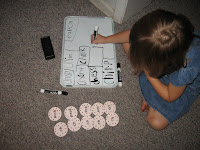
Later, the younger player decided to match the CH cookies with the "ending" cookies and "spell" them on the white board.

Wednesday, September 21, 2011

CH, CH, Chocolate Chip Pancakes


What do "CH" sounds and CHocolate CHip pancakes have in common? Yummy learning!

This morning I ventured to the local grocery for a bag of grapes. Fast forward fifteen minutes into my shopping journey and I found myself dreaming up an engaging learning activity, sure to spark the young ones' curiosities.

Arriving home, I was greeted by three youngers and one older all wondering what was tucked in the grocery bags. To their utter surprise, mom had purchased buy-one-get-one chocolate chip pancake mix. Not the healthiest breakfast choice, but a grocery bargain as well as a catalyst for a morning of learning fun.

We read the box, followed directions, and mixed the ingredients. As I "wrote" in the pan, three pair of eyes gazed eagerly.

"MOM, you wrote a 'C'!"

Yes, indeed! Encouraged by her excitement, I "wrote" another letter.

"MOM, you wrote a 'H'!"

Yes, indeed! We now had two letters bubbling away.

"What sound do they make together?" I inquired. We all made the "CH" sound.

After making a batch of pancakes, we sat to eat. As we enjoyed our yummy CHocolate CHip pancakes we thought of more CH words.

Later in the morning, as I helped the olders with math and language arts, a younger learner cut CH words from the weekly grocery ad, creating a CH meal on a paper plate.

A productive morning indeed!

Saturday, May 30, 2009

Scrabble for All Ages


I jumped and shouted, "Look! Cheez-Its with letters!" Turned heads and puzzled looks were upon me. "Lady, your in the grocery isle." They thought.


I knew where I was but I could not contain my excitement. A new idea had jumped from the grocery shelf and into my brain. I see learning opportunities everywhere, even in the grocery isle, and frankly, a new tool for learning is like a Christmas present under the tree.


I have thought about this new find for several days. Cheez-Its with letters. The new snack is called Cheez-It Scrabble Junior. Do you realize the learning possibilities?


  • Grab a handful fo Cheez-Its. Group them according to letter...all the C's together, all the T's together, etc. Find out which group has more, which group has less. The math and language arts skills involved are for the youngest learners: grouping, set-building and letter recognition.


  • Make an alphabet train. Line up the letters while singing the alphabet and you have the foundations for alphabetizing.


  • Grab a letter, make its phonetic sound, and find items around the house that begin with that letter. Beginning phonics with a fun twist.


  • Use the letters as mini flash cards. Grab a letter and make the sound. Grab another and make the sound. Go through the whole alphabet.


  • Create two letter words: am, an, at, as, ax, be, go, if, in, is, it, me, on, so, and to. Add a letter to each to make three letter words. Spelling at its earliest beginnings.


  • Spell the names of family members. These are high-interest words with a purpose for new spellers.

The possibilities are endless, not to mention, fun, different, and appealing . What a unique introduction to a positively educational game, Scrabble!


While I am on the subject of Scrabble, let me share how this game impacted our learning. Being an "adult game" if you want to classify it as such, it instantly grabbed my son's attention. He wanted to play because he saw Mom and Dad playing. Being a beginning speller did not stop him. He wanted to play. So, I created a "dictionary" for him. I stapled 26 pieces of notebook paper together. Each page was labeled with a letter of the alphabet. Once labeled, I wrote 3-5 letter words which began with the letter written on the top of the page. My son used his "dictionary" to play Scrabble with us. His spelling skills improved and eventually he was able to play without the "dictionary". Our children love a friendly, family game of Scrabble. It's a great way to spend an evening. Honestly, our older boy's vocabulary and spelling skills now surpass Mom and Dad and the kids usually win the game.


Scrabble (and Scrabble Junior) have been the number one spelling tools in our home. You can imagine how excited I was to find Cheez-Its Scrabble Junior on the shelf. I let the ladies in the isle know what an incredible treasure had been discovered.


With all this thought and excitement about letters, I have been reminded of our favorite alphabet books.


  • A is for Asia by C. Chin-Lee

  • P is for Pilgrim by Carol Crane (just one of the many, many titles in a series from the Discover America series...http://www.gale.cengage.com/DiscoverAmerica/guides/

  • Eating the Alphabet: Fruits and Vegetables from A to Z by Lois Ehlert

  • 26 Letters and 99 Cents by Tana Hoban

  • Alphabet City by Stephen Johnson

  • The Airplane Alphabet Book by Jerry Pallotta (just one of the many, many thematic alphabet books he has written)

  • Wild Animals of Africa by H. Ryden
Have fun with language arts today. Education is real and relevant.