Showing posts with label Art. Show all posts

Saturday, September 5, 2015

Torn Paper Rainbows

"Cheryl, take the kids out to see the double rainbow!" 
Mom called, encouraged.


Out we went. Raindrops continued to fall. 
Sun brilliantly overcoming wet shadows. 

Children and I look up, mesmerized, awed!

Like a fresh watercolor. Radiant.

Learning moment launched.

"I want to make a rainbow!"

Pulling from my mind activity file, construction paper colors gathered. Glue found. 

Together, thirty minutes, tearing paper-- fine motor strengthed--a colorful paper rainbow appeared. 

Mesmerized, awed. 


"Mom, look what we created!"

A together moment. A learning moment. 

And a rainbow gleaming through water droplets started the process.

It was simple and it was glorious. 


Saturday, August 15, 2015

"This is a Perfect Book for My Art Appreciation Class!"


Budget cuts in many school districts have cut art and music classes. 


A Harris Poll released in 2005 determined 93% of Americans believe the arts are essential to a well-rounded education.

In our home, art is not part of a budget cut. In fact, art can often be taught well for minimal cost and better yet through a mentoring artist or art enthusiast.

Today we headed to the local library to return items. We purposed only to be in long enough to return books and have the notary sign paperwork for a sports opportunity. An hour later, three floors of shelves investigated--because each child headed off on a rabbit trail (have I mentioned, not planned!) --we left with treasures.


While one learner found the books she needed to add items to her hand-made jewelry collection, another turned around and found Children's Picturebooks: The Art of Visual Storytelling by Martin Salisbury and Morag Styles on an adjacent shelf. She also found Drawing and Painting Animals by Bill Tilton.

From an aisle over I hear, "This is a perfect book for my art appreciation class!"

Appears my high school young adult with The Great Book of Currier & Ives' in America. This book, this HUGE book, is a BEAUTY, every 15 inches in height, 12 inches in width, and 2 1/2 thick piece of it! It has to be one of the biggest books I have ever seen! It set spine up on the shelf as it was too tall for the traditional shelving.

On the way home, two high schoolers seated side-by-side in the car, paged through American history by means of  Currier & Ives. Stunning art definitely appreciated. A great addition, student-interest led, to her art appreciation class.

I will keep you posted on how this book is woven into this year's art appreciation.

Note: I imagine for a student interested in art more than history, this book might spark an interest in our nation's history through its brilliant works. If a student with such interests resides in your home, perhaps a catalog search will reveal this treasure on shelves near you. Just be prepared for an arm workout while hauling it home!

Wednesday, July 15, 2015

Benjamin West: Impromptu Mini Study


Celebrate the simple in learning


It's been a few years and a few children ago that we read Benjamin West and His Cat Grimalkin by Marguerite Henry (yes, the author who wrote the beloved Misty of Chincoteague, another classic worthy of the read). The book introduced us to the Father of American Painting, an artist of whom we were unfamiliar.


Recently, the youngers were introduced to Benjamin and the olders were reacquainted while reading Benjamin West: Gifted Young Painter by Dorothea J. Snow, a biography from the Childhood of Famous Americans series. We were all intrigued, just as we were years ago at our first introduction.

Little known facts we learned:
  • Benjamin wrestled with how his God-given talent could possibly be woven with his Quaker faith, giving his family and his church a new perspective to consider. 
  • Benjamin was creative and industrious, making the best of what he had, from colored clay (insert science study here) to using his cat's fur to make paintbrushes (there is a character lesson of truth telling here but I won't spoil the story).
  • Benjamin was a court painter for King George III. 
  • Benjamin taught famous painters Gilbert Stuart (think famous portrait painter of George Washington) and John Trumbull (think Declaration of Independence) 
Interesting new vocabulary we learned from our reading journey through Benjamin West: Gifted Young Painter .
  • Satchel
  • Provost
  • Ramshackle
  • Aghast
  • Daub
  • Folly
  • Hautboy
  • Chortled
  • Nape
  • Comely
We finished the COFA biography today. As I read the last word of the book, a little perked up, interested:

"We have to find out more!"

Yes, we can. And so can you! Look up these painters in your favorite set of encyclopedia (yes, they still exist), explore Google images, and watch a few You Tube videos.

We:
A good story sparks an interest.

Our little impromptu mini study sparked a new fire.

"Benjamin influenced many artists. Let's find out more about those artists."
  • Charles Willson Peale
  • Gilbert Stuart
  • John Trumbull
  • Thomas Sully
  • Samuel F. B. Morse

A spark ignites an interest, which in turn lights a new fire.

More to do:
  • Differentiate between portrait and self-portrait. Paint or draw your self-portrait.
  • Create a time line of the American history occurring at the time Benjamin West and the other painters were painting. What events were taking place? Did the painters have anything in common?
  • Talk about other events in American history happening about the same time. 
  • If you had the opportunity to meet Benjamin West, Gilbert Stuart or John Turnbull, what questions would you ask them about their work or the time in which they lived? 
  • Learn about the Quaker faith and how it is similar or different from the faith of your family.
  • Read Barbara Brenner's The Boy Who Loved to Draw, biography of Benjamin West. If reading more than one book about Benjamin West, discuss how the books are similar or different. Compare facts in each work.
A spark ignites an interest, which in turn lights a new fire.

That's the ever giving blessing of learning.


Friday, March 7, 2014

Johann Gutenberg and the Printing Press

This past week I prepared and taught a class on Johann Gutenberg for the co-op my children enjoy once a week with eight other families. Children were eager to learn, eager to find out more about the German printer who printed the first Bible on the movable type printing press.

 Johann Gutenberg was born into a wealthy family fortunate enough to have books. Gutenberg, fueled by his passion for the written word was determined to find a way to create books faster than handwriting every word, the norm of his day.


We arrived at co-op early so I could set up my teaching area. Breeze blowing, sun shining brightly, I decided to teach outside. I spent 15 minutes talking about Gutenberg, his biography and his accomplishments. We talked about the printing process and I explained how we would make relief, Styrofoam, and monoprints.


We all enjoyed learning together while enjoying the beautiful day. 

Once home looked on the shelves of our home library for some living books so we could dig deeper in our learning. Indeed, I found a few:

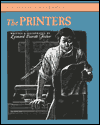
The Printers

If you find your children interested in bringing a part of history alive through printing, here are some resources you might find helpful: 
  • Lessons plans for fruits and veggies prints, styrofoam prints, lithography, monoprints, linoleum block printing, and more - http://www.kinderart.com/printmaking/
  • Styrofoam tray prints - http://tinkerlab.com/abstract-recycled-prints/
  • Nature prints - http://www.cornellplantations.org/sites/default/files/nature_printing.pdf


Wednesday, July 31, 2013

From Interest to Credit

Course development and content varies from high school to high school. The same is true from home school to home school. When developing a high school course for a student, a parent educator can access many resources as guides for content.

This year, due to the talent and interest of one our children, we will be developing a high school drawing and painting class. Drawing and painting? What would a drawing and painting class entail? My mind takes off, thinking of the possibilities.


My first quest, find out what a typical high school drawing and painting class might include. Visiting the DOE site I found Drawing and Painting I, a one-credit course. According the Florida DOE site, the purpose of this course is to "enable students to develop basic perceptual, observational, and compositional skills necessary to communicate a range of subject matter, symbols, ideas, and concepts using knowledge of drawing and painting media, processes, and techniques.The content should include, but not be limited to, the use of tools and materials, art vocabulary, elements of art and principles of design, critical thinking and analysis, historical and cultural perspectives, connections between visual arts and other subject areas, personal and social benefits, collaborative skills, and career opportunities."

I looked at the stated objectives for the course and immediately realized putting together an art class was possible. My daughter and I sat and brainstormed. What specific areas of art are of interest? What media and techniques would she want to experience? Where could we find information and instruction to create a high school level (or above) class? Who might be able to provide mentoring or instruction in this area of interest? What galleries might we be able to visit? How could we incorporate art appreciation and art history into her study?Where might she be able to display art pieces she creates? How is art, or one's knowledge of art, incorporated into various careers?


After our discussion, my daughter's interest turned to self-motivation. She began to dig and discover for herself. What resources we found! I realized her intrinsic interest in drawing and painting could be fostered at home as well as in the community. Real life. Real people. Real art media. Real learning. And, the best part, she had already begun her study...while I was busy finding ways and ideas to support her interest. 


*The information in this blog post is not intended as legal or educational advice. It is simply a journal of what worked for us. Parents are responsible to oversee their child's home education.


Sunday, July 7, 2013

Swimmy


 A one-hour adventure with the beloved Swimmy by Leo Lionni


The preschool and elementary age fish in our school listened eagerly to Swimmy. After the reading, we chose white construction paper from our paper tray and brushed cool-hued watercolors lightly over the entire paper. We had our sights set on a mixed-media collage we found highlighted in 25 Terrific Art ProjectsBased on Favorite Picture Books by Karen Backus, Linda Evans and Mary Thompson.

As we created we strayed from the collage instructions in the book, adding our creativity with twisted tissue paper, sponge- painted seahorses, and torn paper rocks.  The results were amazing! 

My favorite moment of the adventure was the six-year-old's reaction to the fishes failure to cooperate. She sighed, "How sad!" What a character lesson!

Check out Swimmy by Leo Lionni for a powerful example of the importance of working together.

Wednesday, June 12, 2013

Our Eric Carle Unit Study

The Wonderful Art of Eric Carle

(An elementary level, week-long, in-depth study of several titles by the beloved Eric Carle.)

Eric Carle is a talented author/illustrator who excites and inspires young readers with bold illustrations and teachable content. Our youngest four children (preschool to fourth grade) enjoyed a week-long study of Eric Carle. In addition to the experiences mentioned below, we completed many of the activities in Check These Out. By the end of the week, each child proudly displayed her book of Eric Carle art which was bound with a strip of fabric.


On the first day we re-read The Very Hungry Caterpillar, discussed the life cycle of a butterfly and created our own tissue paper collage caterpillar. We watched a biographical video entitled Eric Carle, Picture Writer, set in his studio. Our children loved learning about the man and story behind the stories. 

On the second day we read The Very Busy Spider and discussed the benefits of hard work. Our preschooler made the sounds of the animals and our elementary children discussed the differences between spiders and insects. We all marveled at the raised web on each page of The Very Busy Spider. When it came time to make our own spider page, the fourth grader remembered we had silver glitter glue in the art cabinet, which in her opinion, would make the perfect web. The younger children agreed and soon four very busy spiders were created.


On the third day we read The Grouchy Ladybug. We discussed good and bad attitudes, friendship, manners and the power of the spoken word. Our first grader had a quick review of telling time to the hour, with the help of the clock on each page of Eric Carle's book. Older children found the life cycle of the ladybug fascinating. Finally, we made our own ladybugs with wings which opened (thanks to a brass fastener) to reveal the words "thank you".  Google eyes brought life to the ladybug.

On the fourth day we read Papa, Please Get the Moon for Me.  We talked about the phases of the moon and were determined to watch the moon for a whole month to observe the phases.  For the young ones, we discussed the difference between fiction and non-fiction. We concluded that the book was fiction because a ladder would never reach the moon. We then compared the illustrations of the books we had read and created our own fold-out ladder page for our art book. Later that evening we read Mister Seahorse, discussed the sea life featured in the book and the important role parents play in the lives of their children.  We used scraps of tissue paper from the previous days to create a tissue paper seahorse.

On the fifth day we wrote the corresponding book title on each art masterpiece and bound our book by weaving a scrap of fabric through three paper-punched holes.

Our week did not end there! After analyzing and comparing the art of Eric Carle to the work of other artists, we headed back to the library where our youngest ones selected more Eric Carle titles. Our three year old warmly stated, "Eric Carle is my favorite illustrator." Several weeks later, while on yet another visit to the library, I received another surprise.  I mentioned I needed Mister Seahorse. The library volunteer asked, "Who is the author?" Our six year old chimed in, "Eric Carle."

Just what I had hoped!  In addition to the academics learned, our four budding artists were able to identify, compare, and critique illustrations.

Thursday, October 8, 2009

A is for Art by Stephen T. Johnson


The book jumped off the library shelf! With a candy collage of brightly-colored gum balls, Smarties, and Double Bubble on the cover, it caught my children's attention. As I paged through the clever find before approving it for the library bag, I marveled over the creative use of abstract art.

Every letter of the alphabet is assigned a page, in alphabetical order of course. The page is a piece of abstract art described with alliteration. For example, the letter B is hidden on the "B" page entitled Blueberry Blues. The caption reads "Beside the bisected, black, bumpy bicycle tire, a bunch of busy burgundy brushstrokes blurs into a blue background with a broken bowl below at the bottom." Amazing use of "B" adjectives! Author/illustrator Stephen Johnson gives the reader examples of abstract art described with words that set the mind in motion. Inspiring!

Children find this art particularly intriguing as they feel sure they can produce an eye-pleasing piece. To young children, this art is doable, created with everyday items. In fact, young readers may decide to make their own abstract alphabet book. Not a bad idea.

For readers interested in checking out other Stephen Johnson books, look for:
  • Alphabet City
  • City by Numbers
  • My Little Red Toolbox
and others. Read about them at http://www.stephenjohnsonstudio.com/books/a_is_for_art/

For information about Stephen T. Johnson, visit http://www.stephenjohnsonstudio.com/about/
He has private and permanent collections including the National Portrait Gallery at the Smithsonian Institution in Washington, D. C. and a mosaic mural in the DeKalb Avenue subway station in Brooklyn, New York.

Thursday, July 30, 2009

Clay Day


At a local craft store, my girls cashed in on a 40% off coupon, wrapped their arms around 7 pounds of clay and hurried home to the kitchen table. Clay creations came alive. Our table was covered in gray dust. We used several resources to learn more.

Fun With Modeling Clay by Barbara Reid
Mudworks: Creative Clay, Dough, and Modeling Experiences by MaryAnn F. Kohl


Later, our oldest daughter made some cooked playdough, a huge hit in our home. She used the recipe I used when I taught preschool, emptied all the ingredients into a medium cooking pot and cooked on medium heat until the dough formed a ball. The old recipe was hand-written on a piece of scrap paper and given to me by a mentor teacher. No idea where the teacher found it.
  • 1 c. flour
  • 1/2 c. salt
  • 1 c. water
  • 1 tbsp. vegetable oil
  • 2 tsp. cream of tartar

Wednesday, July 8, 2009

THE END


The story has ended. My last blog, which took place at the end of our school year just days before our vacation, shared the beginning of our collage story. It was a story that began with painted papers intended to be cut into geometric shapes to create a beach scene. The idea was not our original idea, it was an idea we wowed over earlier in the month while reading the book I Love Collage! (you can read about it in one of my earlier blogs). Anyway, back to our beach collage.

After the painted papers dried, we cut out the shapes (yes, a math lesson) and created our scene. The girls helped one another place their shapes and re-cut new ones. In the end we had 4 amazing pictures, each completed at the developmental level of the artist.

I know it has been a long time, over a month, since I last sat to tell the story. I appreciate your patience and hope the anticipation built as you awaited the ending.

Friday, June 5, 2009

Stories Begin at the Beginning

Creation began when God created. Our family began when we said "I do!" Art begins in the mind of an artist.

Today we began our day reading about artists: Giotto, Bellini, De Vinci and Carle. We read their personal stories and learned about their techniques. I told the girls about the amazing paintings I was in an art gallery in Venice. Then we headed to the kitchen table to mix paint. The eleven year old decided to paint modern art. The seven year old painted a landscape like the one she watched Bob Ross paint the day before. The five year old painted Dad a birthday card. Mom and the three year old painted paper. Paper? Yes, papers from which we will cut collage shapes for our collage beach scene. That's this afternoon's story.

So, this blog shares the beginning of our painting story, the one we will conclude later this afternoon. I will tell you about it later when we finish the story

Tuesday, May 26, 2009

I Love to Collage!

I have been working on a writing project and haven't had much extra time lately to tell stories or blog about our "book" fun. However, I did have to blog about our recent find. We found the most incredible, colorful, inviting book at the library last week.

I Love to Collage! by Jennifer Lipsey

Excellent, empowering (especially for kids and parents who think they were born without creativity), and written with step-by-step instructions, this book will inspire the reader to get up and get creative. Many mediums are explored in the twenty ideas detailed between the covers. Tissue paper, newspaper, painted papers, torn papers, garbage (yes, garbage), nature findings and more are used to make amazing art.

My girls were particularly interested in the Tasty Treats project which involved painting papers and then cutting shapes to make a yummy treat. The results were an ice cream sundae and cone. Brilliant hues and impressive images (almost good enough to eat) were the end result.

For those who want to take collage to the next level, here are some suggestions:
1. Study artists who use the collage method, especially children's book illustrators. Look for the art of Eric Carle, Leo Lionni, Lois Ehlert, and Denise Fleming.

A House for Hermit Crab by Eric Carle (painted tissue paper)
Ship Shapes by Stella Blackstone (fabric)
Pie in the Sky by Lois Ehlert (paper)
Snowballs by Lois Ehlert (found object)
Barnyard Banter by Denise Fleming (found objects)

2. Compare the mediums used by these authors. Try using the artist's techniques with found objects from the around the house.

3. Research the history of collage.

4. Visit an art museum. Look for examples of collage art.

Collage is not the only art technique which deserves attention. Find out more about painting, photography, digital art, clay, print making, and drawing. My unit study Check These Out! devotes 4 weeks to discovering children's books, including illustrations. Check These Out! at http://www.cherylbastian.com/bookstore.