Showing posts with label History. Show all posts
Sunday, June 29, 2014
Cornerstones of Freedom- Chronological Listing
Great finds at Friends of the Library used book store at our local library. Within 5 minutes of returning home, littles opened the tote bag, eager to listen to me read. We chose The Pullman Strike. Three paragraphs in, we were hooked, moving fast toward the back cover.
Our afternoon of reading made us curious about others we could acquire. Paula's Archives to the rescue. Not only was there a list of the books in the series but they were in chronological order. Double win! You may find a Cornerstones of Freedom title for your next living history study in the used bookstore of your local library. Happy hunting!
Thursday, June 12, 2014
Read What Interests YOU!
"Honey, this is a great book!"
Words from an engaged read-aloud Dad, spoken sitting aside his daughter; the two of them engrossed in the plot of Kit Carson: Boy Trapper by Augusta Stevenson.
Read what interests you!
Little leaner chose the book from several she pulled from our home library. Eager, she carried her treasure to Dad. Together, they read. Together, they learned.
"Mom, we just read 36 pages!"
Another learner needs a new read...
"Mom, help me find a book."
At the shelf, I locate John Wannamaker: Boy Merchant by Olive W. Burt. I bubble over with excitement! As a child my parents took me to Wannamakers Department Store in Philadelphia to see the Christmas play and hear the organ.
I was hooked! I reminisced, telling my daughter of our train rides to the city and the day in the store. She was hooked, too! We read together. We learned together.
"Mom, read another chapter, please!"
Learning is contagious...
Read what interests you!
Tuesday, April 22, 2014
Makers of America Series Chronological: Living Books Teach History
One of our family's favorite read-aloud series is the Makers of America books. They have taken us from Kitty Hawk to watch the Wright Brothers fly their plane to the wilds of Penn's woods which would eventually be known as Pennsylvania. We have learned history, geography, and science, walking along side some of the brilliant men and women who have made an lasting impact on American history as well as world history. We have loved every sentence of our journey through time.
I found the first of our collection at a used book sale, for 50 cents. Yes, 50 cents! I searched the internet as well as some of my book resources and could not find a listing of the books (if you find one let me know!). Eventually I was able to purchase another book in the same series and it had a partial listing of the books in the series. From that list, I began collecting these hard to find literary treasures. We have loved every one we have read so far.
Made in America series
(may not be a complete listing)
Leif Ericson: Explorer, Ruth Cromer Weir
Christopher Columbus: Discoverer, Alberta Powell Graham (1451-1506)
Champlain: Father of New France, Cecile Pepin Edwards (1574-1653)
Roger Williams: Defender of Freedom, Cecile Pepin Edwards (1603-1683)
La Salle: River Explorer, Alberta Powell Graham (1643-1687)
William Penn: Founder and Friend, Virginia Haviland (1644-1718)
Benjamin Franklin: Printer and Patriot, Ruth Cromer Weir (1706-1790)
George Washington: First President, Elise Ball (1732-1799)
John Paul Jones of the U.S. Navy, Ruth Cromer Weir (1747-1792)
Lafayette: Friend of America, Alberta Powell Graham (1757-1834)
Eli Whitney: Master Craftsman, Miriam Gilbert (1765-1825)
Andrew Jackson: Fighting Frontiersman, Frances Fitzpatrick Wright (1767-1845)
Sam Houston: Fighter and Leader, Frances Fitzpatrick Wright (1793-1863)
Lewis and Clark: Explorers to the West, Madge Haines and Leslie Morrill
Abraham Lincoln: Courageous Leader, Lillian J. Bragdon (1809-1865)
Clara Barton: Red Cross Pioneer, Alberta Powell Graham (1821-1912)
John Muir: Protector of the Wilds, Madge Haines and Leslie Morrill (1838-1914)
Thomas Alva Edison: Inventor, Ruth Cromer Weir (1847-1931)
Luther Burbank: Nature's Helper, Lillian J. Bragdon (1849-1926)
Jane Addams: World Neighbor, Miriam Gilbert (1860-1935)
The Wright Brothers: First to Fly, Madge Haines and Leslie Morrill
Wednesday, April 2, 2014
Living Books: Marco Polo and Co-op
Isn't it fantastic when everything we teach, everything we're involved in as a family, weaves together in a learning tapestry? We try to weave together what we can, but it isn't always possible. Monday it was.
Knowing I would be teaching Marco Polo in our co-op (and I knew next to nothing about him, yikes!) I decided we needed to find a family read-aloud, a book we could all enjoy, a book to get our feet wet, a book to give me some threads on which to weave a lesson (which I would have to teach other people's children!).

Looking on our family home library shelves, I found the perfect read, from one of our favorite series, The Story of Marco Polo by Olive Price. Read the first paragraph, we were immediately swept away to the canals of Venice.
I set up the room with the major landmarks: mountains, Gobi desert, Kashgar (the trading area), and Shangdu (where the Great Khan resided). Blue painter's tape on tile marked the Silk Road. I gave each child a map of Marco's travels and chose three children to be Marco, his father, and his uncle. Each dressed up with sheets of fabric and straddled a stick horse (pretend camel). As I told a synopsis of Marco's venture to the Great Khan, the children moved along "Asia". After I told the story, the three children sat down with the group and I explained "trading along the Silk Road". Each child had a travel pouch and items Marco found or encountered along the journey: silk, coal, jewels, pearls, spices, furs, and paper money. For thirty minutes, children traded along the Silk Road. At the end of the day, they understood a bit more about Marco Polo and his travel across Asia and then along the Spice Route to the south.
Knowing I would be teaching Marco Polo in our co-op (and I knew next to nothing about him, yikes!) I decided we needed to find a family read-aloud, a book we could all enjoy, a book to get our feet wet, a book to give me some threads on which to weave a lesson (which I would have to teach other people's children!).
Looking on our family home library shelves, I found the perfect read, from one of our favorite series, The Story of Marco Polo by Olive Price. Read the first paragraph, we were immediately swept away to the canals of Venice.
"'Today's the day!' cried Marco Polo, a dark-eyed boy nine years old.
Marco pulled aside the yellow silk draperies which hung at a casement window, and looked down on a wide canal. there were few streets in Venice. Almost every passage through the city was a winding waterway.
Marco's home was in a fine part of the town. It was large and filled with beautiful things. Marco lived there with his mother and his faithful servants. "
***
"The day soon came when the great voyage began. Marco Polo set sail from Cathay with two thousand men. He was given a fleet of Chinese ships, each with a crew of three hundred. The ships had splendid sails and were even more seaworthy than any he had seen as a boy in Venice.
The fleet sailed south on the China Sea. It put into ports where Marco saw many new things. He recorded the descriptions of foreign streets and strange people in his notebook. He made drawings of place he had never seen before and charted the roads to them accurately."
We loved the book! In some areas it set ground work. In other areas it filled in gaps with information we hadn't known. It certainly invited us along on Marco Polo's adventure, allowing us to understand the serious crisis Marco met along his journey. I never really appreciated the extent to which navigators risked to give us the geography and understanding we have today.
Forward a few weeks, it came time for me to teach!
Other living books about Marco Polo
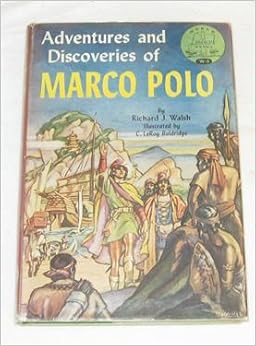
- Adventures and Discoveries of Marco Polo by Richard Walsh (Landmark)
- Adventures of Marco Polo by Russell Freedman
- Marco Polo: A Journey through China by Fiona MacDonald, David Salariya and Mark Bergin
- The Travels of Marco Polo- Volume 1 (other volumes available) by Rustichello of Pisa and Marco Polo and Henry Yule (Kindle version of Polo's manuscript, primary source for high schoolers)
NOTE: In almost every book I've read, there is content which could be considered controversial. This book, The Story of Marco Polo, is no different. I must note, having read the book and penning a post, there is mention of cannibals in Sumatra. As with any book, the parent must decide how and when to handle content with their family.
Saturday, March 29, 2014
Living Books Forum: A Book Ignited a Fire...A Learning Fire!
Do you have a childhood favorite read, one that impacted you so greatly you remember every page?
Maybe a picture book, a chapter book?
After reading your favorite book, did you reach for others by the same author? The same topic or genre?
Not long ago one of the learners in my home read a book that started a literary fire, a fire that burned brightly for months, actually almost a year if you count all the extended studies ignited off to the side.
The book that started the fire?
The Story of Florence Nightingale by Margaret Leighton
I remember the evening she finished the book. She closed the book, clutched it to her chest, and remarked, "That was a good book! I feel like I know Florence Nightingale. I know the trials she faced as she treated people. I know about her courage to do something other people thought she shouldn't do. That was a good book!"
"Do we have any other nurse books?"
Wow! The power of a story!
We walked to the bookshelf and pull a few others. One after another, they were read, each time adding another layer of learning. When she read the all books we owned, we looked for more.
Eventually her study broadened to women who changed medical science. That leg of the learning journey became a biographical science project (really mini research projects grouped into one) which spark studies in human anatomy and physiology, later branched to health and nutrition. Each learning segment was sparked by the one before, but ignited by one book.
The Story of Florence Nightingale by Margaret Leighton
Keeping great books--books that are alive and carry the reader into the story-- in my home is one of my greatest pursuits. Finding books which capture attention and ignite learning, all the while building reading confidence and fluency. Finding books is now part of my yearly planning as I consider curricula for the coming year. Sometimes I comment, "I used to spend hours thumbing through catalogs, now I reference book lists and search garage sales, used bookstores, and Ebay". When we find literary treasures, eyes light up. Learning fires are started!
Are there books in your home that ignite learning?
Do you want to learn more about how you can spark interest?
Join us at Living Books Forum, April 5, just one week away.
Workshop descriptions here.
Register here.
Friday, March 28, 2014
Living Books Forum: Excerpt from The Wright Brothers: First to Fly by Madge Haines and Leslie Morrill
What is a living book? Another mom inquires. A term best defined by an excerpt, a sample.
Here are a few excerpts from one in a series we enjoy, Makers of America. The book is titled The Wright Brothers: First to Fly by Madge Haines and Leslie Morrill and invites the reader on adventures of experimentation with the Wright brothers from the time they were young boys to their famous flight.
"One evening Wilbur said to Orville, 'I wish I could find the scientific law that made the small helicopter rise. Then I think I could figure out why the big one we made did not fly.'
'I'll bring you some books from the town library,' Orville offered. 'I know you have ready everything your're interested in, in Father's library.'
During those months while Wilbur was slowly gaining his strength, he used his hands in making light, delicate things. He became very skillful in using chisels and tools. He read books and magazine articles on the subject of flying.
As Orville came into his room one evening. Wilbur looked up from a magazine and spoke with a new note of eagerness. 'A man in Germany has made a glider that can carry him through the air.'
***
'Otto Lilienthal. He has been experimenting with gliders. He waits for a strong breeze, then he runs down a hill into the wind, and the glider actually carries him.' Wilbur was demonstrating with his arms.
Orville reached over to take the magazine from his brother. 'Why don't we make one?'
Wilbur nodded. 'But we'd better do some studying first.'"
***
"With the wind blowing harder then ever, the plane kept climbing. Now it was ten feet off the ground and still in the air. Now it was flying right away from Wilbur.
The boy who had been watching jerked off his cap and waved and shouted, 'He's flying! He's flying!'
Orville did not hear. He was too busy trying to steer the plane and to think of what was happening...with 'the machine moving forward, the air flying backward, the propeller turning sidewise, and nothing standing still.'
In a few seconds the plane began to come down, but it did not crash. It settled gently on the sand.
'How long was I up?'
'Twelve seconds!'
There are living books for almost every subject, at every reading level, from beginning readers through adult.
How do we incorporate those into our days?
One simple way is to have the books available, in your home, where children and young adults have them accessible.
Tina Farewell and I will be sharing how to build a home library with title your children will enjoy. Later in the morning Tina will be sharing how to teach grammar, vocabulary, mechanics and conversation from the contents of living books. I will be offering a workshop on using living books (real books) through the high school years.
Workshop descriptions for ALL the workshops offered at Living Books Forum can be found here.
Come to Living Books Forum and you will gain lists of titles as well as practical helps to make learning engaging and memorable in your home.
Saturday, March 22, 2014
Living Books Forum- Question Asked, Answers Offered
Great question asked today. It was posted over on the Living Books Forum Facebook page. I thought I would post it hear with the comments posted with hope the answers may help parents wrestling with what Living Books are and how they are used in the home school.Question:
I heard Living Books are part of the Charlotte Mason philosophy of education. I don't use the CM approach. Will I be able to apply what I learn at the Living Books Forum to our homeschool?
Cheryl answered, "Absolutely! Books that allow for learning, no matter what your philosophy may be. The Story of Louis Pasteur is an amazing Living Book which allows the reader to walk alongside Louis in the chem lab to grow bacteria and across the ocean to find a solution for the French silk industry. The biography is a GREAT book, a Living Book because the reader is living at the time of the setting. This book could be incorporated into a classical cycle of history or a unit study. It could be used as a source for a traditional research paper. It makes a great addition to an independent chemistry study. So, though the book may be called a Living Book by Charlotte Mason, it is at the core, a biography that can be woven into any study in any educational philosophy."
Tina responded, "What are some other terms for Living Books? Dr. Ruth Beechick also called them Whole Books and Real Books. Some call them Classics. Some call them Library Books! Simply put, they are books that are typically written by one author who loves the subject and that shines through the book. It causes something noble in the heart of the reader and often begs to be read again and again.
Friday, March 7, 2014
Johann Gutenberg and the Printing Press
This past week I prepared and taught a class on Johann Gutenberg for the co-op my children enjoy once a week with eight other families. Children were eager to learn, eager to find out more about the German printer who printed the first Bible on the movable type printing press.
Johann Gutenberg was born into a wealthy family fortunate enough to have books. Gutenberg, fueled by his passion for the written word was determined to find a way to create books faster than handwriting every word, the norm of his day.

We arrived at co-op early so I could set up my teaching area. Breeze blowing, sun shining brightly, I decided to teach outside. I spent 15 minutes talking about Gutenberg, his biography and his accomplishments. We talked about the printing process and I explained how we would make relief, Styrofoam, and monoprints.
We all enjoyed learning together while enjoying the beautiful day.
Once home looked on the shelves of our home library for some living books so we could dig deeper in our learning. Indeed, I found a few:
- Marguerite Makes a Book, Bruce Robertson
- The Printers, Leonard Everett Fisher (Colonial American Craftsmen series)
- The Papermakers, Leonard Everett Fisher (Colonial American Craftsmen series)
If you find your children interested in bringing a part of history alive through printing, here are some resources you might find helpful:
- Lessons plans for fruits and veggies prints, styrofoam prints, lithography, monoprints, linoleum block printing, and more - http://www.kinderart.com/printmaking/
- Styrofoam tray prints - http://tinkerlab.com/abstract-recycled-prints/
- Nature prints - http://www.cornellplantations.org/sites/default/files/nature_printing.pdf
Monday, November 4, 2013
The Power of Experiential Learning- Medieval Life
One learner requests a vocabulary and spelling list of the words learned. Gladly!
A week later we attend the Renaissance Fair not far from our home. Great family trip of discovery. Thankful for the timing!
At the fair we talk to people in period dress, shoot bow and arrow, learn new skills.
A fun unit. History lived, history learned.
Inspired by the activities at the fair, determined to "own" a bow and arrow, PVC pipe and weed wacker cording were found, crafted into a bow. Blunt-end dowel rods served as arrows. I marvel at the ingenuity. Thankful for the Saturday they have to create together. Time is a precious commodity.
Targets dry, eventually, due to thick coats of paint. Hung on the backyard playset. Safety rules considered.
Ping! Ping!
"I got a 100!"
"I am a pretty good shot!" One learner boasts.
"This is the most fun sport ever!" A little learner announces.
"Seems like we are Medieval!" Another little learner proclaims.
I smile thankful for the moms who, with their efforts and enthusiasm at co-op, started us on this two-week study.
From the other end of the house, I hear a little learner wonder, "Do you think mom will let us get out the tepee?"
Moving right along in history.
Monday, July 22, 2013
"Mom, I Want to Build Something!"

The most recent statement from our child who recently announced,
"I want to be an engineer."
How did that child come to that conclusion? Not certain we had ever done an "engineer" study. Must know an engineer? Did the child overhear conversation with an engineer? Hmmm. Where did the revelation come from?
A child has a longing, a desire. Louis Pasteur asked questions and searched for answers. He got answers, and saved lives. The Wright Brothers wanted to fly. They experimented and they did. A child inspired. Where will that inspiration lead? Pondering how to fan the flames, like Jeanne Roqui, Susan Wright, and many other moms.
Another day another idea.
Finding some PVC pipes, elbow and connectors, a tent frame erected in the front yard. Same child.
Now, convinced this is more than a passing thought, I notice the common thread. Building is part of the unique design.
Almost immediately I remembered an older sibling designing with an extensive set of KNEX, 13 years ago. Dug out of the back of a closet, the set was reopened, rediscovered, pieces rumbling. Something was happening, like a mind-quake.
What is being built? The curiosity bubbled inside me. I couldn't wait to see the results of a imaginative mind, a curiosity.
Before long..
"Look what I built!"
Complete with a rotary dial, which was added after consultation with an older sibling.
"Mom, I want to build something!"
What an ingenious builder you are!
How can I help you be the best builder you can be?
Pondering...
Thursday, July 4, 2013
America's Birthday
As we put the finishing touches on a vegetable tray for a
Fourth of July celebration, our inquisitive three year old questioned,
"Where are we going?"
I looked down at her bright smiling face and answered,
"To Uncle Brian's party."
Immediately she responded with yet another question. "Who's birthday is it?"
Of course a three year old might consider that every party
is a birthday party. I smiled and
chuckled inside as I replied, "It's America's birthday."
Looking for July 4th teaching resources? Check out The Teaching Nook.
Saturday, April 20, 2013
Can Living Books Teach History?
I read this common question, or variations, in my inbox this time of year, every year. I usually answer something like:
Question: As I start the look into what we will do next year. I have been thinking about history. Next year I will have a 4th,2nd, and 1st grader. Someone mentioned Childhood of Famous Americans to me. I am looking for something to do maybe twice a week as the other days we have other activities. Could you comment on my thoughts.
Reading aloud returns great rewards. Auditory processing, the ability to process what is heard, develops as children listen to audio materials. Comprehension improves as participants ask questions and retell parts of the story. Vocabulary builds as the reader explains unknown words. Attention span increases as listeners sit eager to hear a story unfold. Relationships deepen as reader and listeners share emotions, thoughts and ideas. Reading aloud returns great rewards at any age.
In response to the question raised by this mom (and many others like her now considering their curriculum choices for the coming year), she was specifically interested in Childhood of Famous Americans (the hardcovers if you can find them), for the ages posted. Older children may be interested in the Landmark books, biographies in the Signature series or We Were There books.
Question: As I start the look into what we will do next year. I have been thinking about history. Next year I will have a 4th,2nd, and 1st grader. Someone mentioned Childhood of Famous Americans to me. I am looking for something to do maybe twice a week as the other days we have other activities. Could you comment on my thoughts.
Reading aloud returns great rewards. Auditory processing, the ability to process what is heard, develops as children listen to audio materials. Comprehension improves as participants ask questions and retell parts of the story. Vocabulary builds as the reader explains unknown words. Attention span increases as listeners sit eager to hear a story unfold. Relationships deepen as reader and listeners share emotions, thoughts and ideas. Reading aloud returns great rewards at any age.
In response to the question raised by this mom (and many others like her now considering their curriculum choices for the coming year), she was specifically interested in Childhood of Famous Americans (the hardcovers if you can find them), for the ages posted. Older children may be interested in the Landmark books, biographies in the Signature series or We Were There books.
With the ages stated, these books can be read, comprehended and enjoyed together, as a family. Each child will gather details they find most intriguing. In our home we read in the afternoon before Dad comes home while toddler is still napping or later in
the evening right before bed after jammies are on and teeth are brushed. Little eyes and
bodies relaxed, transition to bed is easy. Family read-aloud time offers priceless memories of siblings and parents snuggled in the living room, reading.
Reading COFAs is a way to learn history and science. Children quickly become interested in COFA stories because the main characters are introduced as children. As to which title to choose, it is beneficial if the child chooses which title he would like to read first. Children are more likely to engage immediately and intently if their interest is piqued. Remember the content of COFAs lend themselves to history and science. Often as parents read, children begin to think how they can "study" the subject in more detail, maybe designing a lapbook, maybe helping to create a unit study, maybe acting out a historical event or dressing up as the main character, maybe simply checking out library books on the subject for deeper learning.
If the listener is a reader, he or she may become so interested that independent reading may become a personal motivation. The result may be heading to the home library shelf to choose another independent read. COFAs make great independent reads, encouraging reading growth and fluency while learning history.
Younger readers, not quite ready to read a COFA independently, may enjoy choosing a similar title in the Step-Up book series. The reading level is lower than COFAs and make great reads for emerging readers. They are well-written and kids LOVE the content.
Can history be studied reading "living books", books which allow the listener/reader to journey alongside characters? Absolutely! In fact, it is the stories our children have "lived" that are best remembered.
Younger readers, not quite ready to read a COFA independently, may enjoy choosing a similar title in the Step-Up book series. The reading level is lower than COFAs and make great reads for emerging readers. They are well-written and kids LOVE the content.
Can history be studied reading "living books", books which allow the listener/reader to journey alongside characters? Absolutely! In fact, it is the stories our children have "lived" that are best remembered.
Thursday, April 18, 2013
Live History with Landmark Books Part II
A few days ago I posted the 122 titles of the American titles in the Landmark series. Today I am adding the 63 titles in the World series so families can round out their collection. The above picture includes one of each.
The 63 titles in the World Landmark series
1 The First Men In the World by Anne Terry
White
2 Alexander
the Great by John Gunther
3 Adventures
and Discoveries of Marco Polo by Richard Walsh
4 Joan of
Arc by Nancy Wilson Ross
5 King
Arthur and His Knights by Mabel Louise Robinson
6 Mary,
Queen of Scots by Emily Hahn
7 Napoleon
and the Battle of Waterloo by Frances Winwar
8 Royal
Canadian Mounted Police by Richard L Neuberger
9 The Man
Who Changed China: The Story of Sun Yat-sen by Pearl S. Buck
10 The Battle of Britain
by Quentin Reynolds
11 The
Crusades by Anthony West
12 Genghis
Khan and the Mongol Horde by Harold Lamb
13 Queen
Elizabeth and the Spanish Armada by Francis Winwar
14 Simon
Bolivar, the Great Liberator by Arnold
Whitridge
15 The
Slave Who Freed Haiti :
The Story of Toussaint Louverture by
Katerine Scherman
16 The Story
of Scotland Yard by Laurence Thompson
17 The Life
of Saint Patrick by Quentin Reynolds
18 The
Exploits of Xenophon by Geoffrey Household
19 Captain
Cook Explores the South Seas by Armstrong
Sperry
20 Marie
Antoinette by Bernadine Kielty
21 Will
Shakespeare and the Globe Theater by Anne Terry White
22 The
French Foreign Legion by Wyatt Blassingame
23 Martin
Luther by Harry Emerson Fosdick
24 The Hudson ’s Bay Company
by Richard Morenus
25 Balboa:
Swordsman Conquistador by Felix Riesenberg
26 The
Magna Charta by James Daugherty
27 Leonardo
da Vinci by Emily Hahn
28 General
Brock and Niagara Falls by Samuel Hopkins Adams
29 Catherine
the Great by Katherine Scherman
30 The Fall
of Constantinople by Bernadine Kielty
31 Ferdinand
Magellan: Master Mariner by Seymour
Gates Pond
32 Garibaldi:
Father of Modern Italy
by Marcia Davenport
33 The
Story of Albert Schweitzer by Anita Daniel
34 The
Marquis de Lafayette: Bright Sword of Freedom by Hodding Carter
35 Famous
Pirates of the New World by A. B. C.
Whipple
36 Exploring
the Himalaya by William O. Douglas
37 Queen
Victoria by Noel Streatfeild
38 The
Flight and Adventures of Charles II by Charles Norman
39 Chief of the Cossacks by Harold Lamb
40 Adventures
of Ulysses by Gerald Gottlieb
41 William
the Conqueror by Thomas B. Costain
42 Jesus
of Nazareth
by Harry Emerson Fosdick
43 Julius
Caesar by John Gunther
44 The
Story of Australia
by A. Grove Day
45 Captain
Cortes Conquers Mexico
by William Johnson
46 Florence Nightingale by Ruth Fox Hume
47 The
Rise and Fall of Adolf Hitler by William L. Shirer
48 The
Story of Atomic Energy by Laura Fermi
49 Great
Men of Medicine by Ruth Fox Hume
50 Cleopatra
of Egypt
by Leonora Hornblow
51 The
Sinking of the Bismarck
by William L. Shirer
52 Lawrence of Arabia by Alistair MacLean
53 The
Life of Saint Paul
by Harry Emerson Fosdick
54 The
Voyages of Henry Hudson by Eugene Rachlis
55 Hero
of Trafalgar by A. B. C. Whipple
56 Winston
Churchill by Quentin Reynolds
57 The
War of Korea :
1950 - 1953 by Robert Leckie
58 Walter
Raleigh by Henrietta Buckmaster
59 Pharaohs
of Ancient Egypt
by Elizabeth Payne
60 Flying
Aces of World War I by Gene Gurney
61 Commandos
of World War II by Hodding Carter
62 Ben
Gurion and the Birth of Israel
by Joan Comay
63 The
United Nations in War and Peace by T. R. Fehrenback
Subscribe to:
Posts (Atom)