Tuesday, April 22, 2014
Makers of America Series Chronological: Living Books Teach History
Wednesday, June 12, 2013
Our Eric Carle Unit Study
Just what I had hoped! In addition to the academics learned, our four budding artists were able to identify, compare, and critique illustrations.
Sunday, July 29, 2012
The Wright Brothers
Looking for a new read-aloud, we headed to our home library. Majority vote determined The Wright Brothers (from the Landmark series) by Quentin Reynolds would be our next read. From the very first page, we were captivated. Science, geography, life application. Encouragement for mom. A great read for sure!
Side note: This book spoke to me as a mom who strives to encourage children to ask questions, to remain curious, to love learning. Pages 4-6 impacted me, so much so that I often quote this passage when I speak to mama of little learners. Susan Wright inspired her children with her ability to encourage questions and cultivated wonder. Her efforts changed technology.
"What makes a bird fly, Mother?" Wilbur asked.
"Their wings, Will," she said. "You notice they move their wings and that makes them go faster."
"But Mother, " Will said, not quite satisfied, "that bird that just swooped down didn't even move his wings. He swooped down and grabbed a fish, and then went right up again. He never moved his wings at all."
"The wind doesn't just blow toward you or away from you," she said. "It blows up and down too. When a current of air blows up, it takes the bird up. This wings support him in the air."
The story continues as the brothers ask their mother questions about what they were observing. Wilbur insists he could fly if he had wings, if he could make wings. The narrator concludes the chapter:
"She knew that even an eleven-year-old boy can have ideas of his own, and just because they happened to come from an eleven-year-old head--well, that didn't make them foolish. She never treated her children as if they were babies, and perhaps that's why they liked to go fishing with her or on picnics with her. And that's why they kept asking her questions.
We finished the book and our children wanted to learn more about the Wright Brothers and flight. That interest led to asking the local butcher for Styrofoam meat trays from which we cut glider wings. Gliders led to creating a Science Fair project which hypothesized the effect of paper weight on the flight of paper airplanes. We folded, flew, measured and compared. What a journey! It all started with a trip to our home library.
Books
The Wright Brothers by Elizabeth MacLeod
To Fly: The Story of the Wright Brothers by Wendie C. Old
First Flight: The Story of Tom Tate and the Wright Brothers by George Shea
Learning resources
Monday, September 19, 2011
It's A Revolution!
Friday, July 1, 2011
On the Edge of Our Seats
"Read one more!" My daughters pleaded.
Chapters in in the life of Betsy Ross are unfolding in our home. Quakers. Samplers. John Ross. The woven tapestry of Betsy Ross: Designer of Our Flag is just one book in the well-known Childhood of Famous Americans series. Author Ann Weil transports readers to the streets of pre-Revolutionary Philadelphia where Betsy enters the High Street Fair. A Quaker, the path to the fair was less than smooth, riddled with decisions, questions, and reflection. And we are in the midst, wrestling with Betsy's thoughts and then...well, I just can't say. It would ruin the story.
What will become of John Ross? When will Betsy sew the flag? We must keep reading to find out.
- Information about the American flag
- Learn flag etiquette and how to display the American flag
- Visit the interactive site of the National Museum of American History to learn more about the Star Spangled Banner
- How to cut a five-pointed star
- Find out more about the Betsy Ross house in Philadelphia. Visit if you have the ability.
- Learn about the main People of the Revolution.
- Listen to Revolutionary music and learn more about the music birthed from our young nation.
- Philadelphia on a map. In which state is Philadelphia located? How much distance is between Philadelphia and the city in which you live?
- Cut out a fabric star and appliqué to a piece of broadcloth.
- Make a timeline of events as related to the United States flag.
- Make a patriot craft
- Learn the lyrics to patriotic songs
Wednesday, June 22, 2011
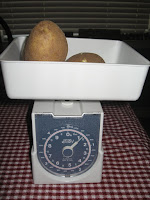
One Potato, Two Potato
- Estimate the weight of a watermelon. Weigh on a bathroom scale. Figure out the price per paid per pound.
- Purchase a five pound bag of potatoes. Compare the quantity with a five pound bag of onions. Why the difference in quantity per pound? Younger children can weigh potatoes and arrange from lightest to heaviest.
- Buy a basket full of veggie. Sort according to what part of the plant is eaten: stem, leaf, seed, root, flower. Eat vegetables and dip for snack.
- Read Growing Vegetable Soup by Lois Ehlert. Make veggie soup for dinner. (Dad will love eating what the children learned.)
- Read the Farm Alphabet Book by Jane Miller. Make your own fruits and veggies alphabet book.
- Play Garden Match to learn beginning consonants.
- Read Eating the Alphabet: Fruits and Vegetables from A to Z by Lois Ehlert.
- Read Stone Soup by Marcia Brown (a traditional tale).
- Read Tops and Bottoms by Janet Stevens (a trickster tale).
- Make a growing vegetable soup lapbook.
- Read The Tiny Seed by Eric Carle.
- Tour the produce section of the grocery store.
- Visit a working farm, garden store, orchard, or greenhouse.
- Pla
nt a garden.
- Build a grow box and grow herbs.
- Spout seeds. Discuss vocabulary: seeds, seedlings, cuttings, sprout, germinate.
- Read The Vegetables We Eat by Gail Gibbons
- Read Green Beans, Potatoes, and Even Tomatoes by Brian Cleary
- Read One Bean by Anne Rockwell.
- Sprout an avocado seed.
- Grow or purchase a pie pumpkin. Open. Clean. Bake. Puree pumpkin and make bread.
- Read The Life Cycle of a Bean by Linda Tagliaferro.
- Read Foods from Farms by Nancy Dickmann.
- Read Plants on a Farm by Nancy Dickmann.
- Read Farming by Gail Gibbons. Discuss farming around the world.
- Read From Seed to Plant by Gail Gibbons.
- Read Planting a Rainbow by Lois Ehlert.
- Read The Victory Garden Vegetable Alphabet Book by Jerry Pallotta.
- Make prints using tempera paints and fruits and veggies (potato, cabbage, celery, corn, and oranges)
- Read Linnea in Monet's Garden by Christina Bjork.
- Make a seed collage.
- Sing Oats, Peas, Beans and Barley Grow. Act out the song with motions.
- Read How Are You Peeling? by Joost Effers and Saxton Freymann. Discuss the illustrations. Children may also enjoy Fast Food by the same authors.
- Play Hot Potato (hand-eye coordination)
Thursday, November 18, 2010
Math in Our Lunch

We've encountered math in our lunch! Amazing how the best math lessons seem to happen spontaneously. How, you ask? Here are some examples (with some added extras for the adventurous):
- Cut deli-sliced cheese and meat into equal parts. Discuss halves, quarters, thirds. Write the fractions (to extend to the symbolic representation).
- Cut a sandwich in two equal pieces. Discuss equal and half. Write the fraction. Older children could cut sandwich into fourths. Discuss equal fractions and introduce adding fractions with like denominators.
- Cut rectangle slices off the end of a rectangular prism of cheese. Find other rectangular prisms in the kitchen (boxes of crackers, cereal, tea bags, etc.).
- Identify additional solid figures (cubes, cones, spheres, and cylinders). Compare to geometric shapes: circle, rectangle, square, triangle, and oval.
- Cut each rectangle slices of cheese into two squares and placed on a circular cracker. Find other squares and circles around the house. Look for right angles. Discuss straight and curved lines. Estimate the circumference of the cracker. Write the number to represent the estimate. Measure circumference of the cracker with a string and then measure the string with a ruler. Write the actual length and find the difference between the estimate and the actual.
- Measured the height, length, and width of the faces of the cheese block. Older children could calculate the volume.
- Discussed right angles, sides, angles, faces, length, width, height, circumference, diameter, and radius.
Helpful resources:
http://www.mathsisfun.com/geometry/cuboids-rectangular-prisms.html (concept explanations)
http://www.tcpl.lib.in.us/youth/mathconcepts.htm (book lists for related math topics)
http://www2.ed.gov/pubs/parents/Math/grocerymath.html (math in the grocery store)
Saturday, June 5, 2010
Summer Reading List

Summer peaks around the corner. For some people packing for vacation is first and foremost on the mind. For others, summer camps and mission trips demand last minute trips to variety stores to purchase last minute necessities. In the midst of preparing for what summer will bring to our families, some of us are also visiting local libraries and used book sales to gather summer reading materials. For those who have asked about summer reading possibilities, I write this blog. The titles have been compiled over the years and are printed in Appendix D of my book You HAVE to Read This One: Raising a Contagious Reader.
"Parents choose reading materials for their children based upon several factors:
• a student’s reading ability and maturity,
• family’s values and worldview, and
• whether a book is to be read aloud or read independently.
All these factors, or a combination of these factors, will determine what titles are appropriate for your children. My list was complied for parents with upper elementary (grades 4-5) and middle school (grades 6-8) students.
The spectrum of age and maturity of students in grades four through eight is great. As a guide, I have marked titles considered more difficult—by vocabulary or content— with (M). Parents may decide to wait until grades 7-8 to introduce these books. Selections marked (2-4) may be considered acceptable read-aloud titles for grades 2-4. As always, if in doubt, read the book first."
• Adams, Richard, Watership Down (M)
• Alcott, Louisa May, Little Men (M)
• Alcott, Louisa May, Little Women (M)
• Allman, Barbara, Musical Genius
• Andersen, Hans Christian, Hans Andersen’s Fairy Tales
• Armstrong, William, Sounder
• Atwater, Richard and Florence, Mr. Popper’s Penguins
• Bagnold, Enid, National Velvet
• Barrie, J. M., Peter Pan
• Baum, L. Frank, The Wizard of Oz
• Beatty, Patricia, Turn Homeward Hannalee
• Beechick, Ruth, Adam and His Kin
• Blackmore, R. D., Lorna Doone
• Brink, Carol Ryrie, Caddie Woodlawn
• Bulla, Clyde Robert, A Lion to Guard Us
• Burnett, Frances Hodgson, Little Lord Fauntleroy
• Carroll, Lewis, Alice in Wonderland
• Collodi, Carlo, Pinocchio
• Crane, Stephen, The Red Badge of Courage (M)
• Coerr, Eleanor, Sadako and the Thousand Paper Cranes
• Crockett, Davy, The Life of David Crockett (M)
• D’Angeli, Marguerite, The Door in the Wall
• Dalgliesh, Alice, The Courage of Sarah Noble (2-4)
• Defoe, Daniel, The Life and Adventures of Robinson Crusoe
• DeJong, Meindert, The Wheel on the School (M)
• Dickens, Charles, A Christmas Carol (M)
• Dickens, Charles, A Tale of Two Cities (M)
• Dickens, Charles, Great Expectations (M)
• Dickens, Charles, Oliver Twist (M)
• du Bois, William Pene, The Twenty-One Balloons (M)
• Edmonds, Walter D., The Matchlock Gun (2-4)
• Equiano, Olaudah, The Kidnapped Prince
• Finley, Martha, Elise Densmore
• Fleischman, Sid, By the Great Horn Spoon!
• Fleischman, Sid, The Whipping Boy
• Forbes, Esther, Johnny Tremain (M)
• Fritz, Jean, The Cabin Faced West (2-4)
• George, Jean Craighead, Julie of the Wolves
• George, Jean Craighead, My Side of the Mountain
• Gipson, Fred, Old Yeller
• Gray, Elizabeth Janet, Adam of the Road
• Green, Roger Lancelyn, Tales of Ancient Egypt (M)
• Green, Roger Lancelyn, The Adventures of Robin Hood
• Green, Roger Lancelyn, The Tale of Troy
• Hawthorne, Nathaniel, The Scarlet Letter (M)
• Henty, G.A., Beric the Briton
• Henty, G. A., Cat of Bubastes
• Henty, G. A., For the Temple
• Henty, G. A., Young Carthaginian
• Homer, The Odyssey
• Homer, The Illiad
• Hugo, Victor, The Hunchback of Notre Dame (M)
• Hunt, Irene, Across Five Aprils (M)
• Hunt, Irene, Up the Road Slowly (M)
• Keith, Harold, Rifles for Watie
• Kelly, Eric P., The Trumpeter of Krakow (M)
• Kipling, Rudyard, Captains Courageous
• Kipling, Rudyard, Just So Stories
• Kipling, Rudyard, The Jungle Book
• Langford, Alan, Tales of the Greek Heroes (M)
• Lee, Harper, To Kill a Mockingbird (M)
• Latham, Jean Lee, Carry On, Mr. Bowditch
• Lawson, Robert, Rabbit Hill
• L’Engle, Madeleine, A Wrinkle in Time
• Lenski, Lois, The Strawberry Girl (2-4)
• Lewis, C.S., The Lion, the Witch and the Wardrobe
• Lindgren, Astrid, Pippi Longstocking
• Lofting, Hugh, Doctor Dolittle Stories
• London, Jack, The Call of the Wild
• London, Jack, White Fang
• Macdonald, George, The Princess and the Goblin
• McGraw, Eloise Jarvis, Mara, Daughter of the Nile
• McGraw, Eloise Jarvis, The Golden Goblet
• Montgomery, Lucy Maud, Anne of Green Gables
• Morey, Walt, Gentle Ben
• Norton, Mary, The Borrowers (2-4)
• O’Dell, Scott, Island of the Blue Dolphins
• O’Dell, Scott, The Hawk that Dare Not Hunt by Day (M)
• Porter, Eleanor, Pollyanna (2-4)
• Rawlings, Marjorie Kinnan, The Yearling (M)
• Rawls, Wilson, Where the Red Fern Grows
• Richter, Conrad, The Light in the Forest
• Sewell, Anna, Black Beauty
• Sharp, Margery, The Rescuers
• Sheldon, George, The Cricket in Times Square
• Speare, Elizabeth George, Calico Captive
• Speare, Elizabeth George, The Bronze Bow
• Speare, Elizabeth George, The Sign of the Beaver
• Speare, Elizabeth George, The Witch of Blackbird Pond (M)
• Spyri, Johanna, Heidi
• Stevenson, Robert Louis, A Child’s Garden of Verses
• Stevenson, Robert Louis, Treasure Island
• Swift, Jonathan, Gulliver's Travels
• Taylor, Mildred, Roll of Thunder, Hear My Cry (M)
• ten Boom, Corrie, The Hiding Place (M)
• Tolkien, J.R.R, The Hobbit
• Tolkien, J.R.R., Fellowship of the Rings
• Twain, Mark, The Adventures of Huckleberry Finn (M)
• Twain, Mark, The Adventures of Tom Sawyer (M)
• Vern, Jules, 20,000 Leagues Under the Sea (M)
• Vern, Jules, Around the World in Eighty Days
• Vern, Jules, Journey to the Center of the Earth (M)
• Wells, H. G., Time Machine (M)
• White, E. B., Charlotte’s Web (2-4)
• White, E. B., Stuart Little
• Wiggin, Kate Douglas, Rebecca of Sunnybrook Farm
• Williamson, Joanne, Hittite Warrior
• Wyss, Jonathan David, Swiss Family Robinson
• Yates, Elizabeth, Amos Fortune Free Man
May this reading list is a springboard to many summer adventures!
Wednesday, May 26, 2010
Read Around the World
Travel the world and never leave your living room. Though there are distinct advantages to learning about the Colosseum while walking its cobblestone path ways or climbing to the top on worn stone steps, many of us will never have an opportunity to do so. That's where books span the ravine of being there to taking us there.Books set in cultures and countries afar, allow us to walk across the Grand Canal, explore the Sahara, swim the English Channel, or climb the Rocky Mountains. In doing so, books broade
n horizons, teaching geography and immersing us in culture as we read.Travel the United States with:
In My Mother's House by Ann Nolan Clark
M is for Majestic: A National Parks Alphabet by David Domeniconi
The Great St. Lawrence Seaway by Gail Gibbons
Minn of the Mississippi by Holling C. Holling
Carry On, Mr. Bowditch by Jean Latham
Strawberry Girl by Lois Lenski (chapter book)
Lentil by Robert McCloskey
Time of Wonder by Robert McCloskey
N is for Our Nation's Capital by Roland Smith
The Little Red Lighthouse and the Great Gray Bridge by Hildegarde H. Swift
A New Coat for Anna by Harriet Ziefert
Traveled the World with:
A Ride on Mother's Back: A Day of Baby Carrying Around the World by Emery and Durga Bernhard
The Apple and the Arrow by Mary and Conrad Bluff
Secret of the Andes by Ann Nolan Clark (chapter book)
The Wheel on the School by Meindert deJong (chapter book)
A Life Like Mine published by DK Publishing
Children Just Like Me by Anabel Kindersley
The Story of Ferdinand by Munro Leaf
A Pair of Red Clogs by Masako Matsuno
Bread, Bread, Bread by Ann Morris
House and Homes by Ann Morris
How to Make an Apple Pie and See the World by Marjorie Priceman
The Glorious Flight by Alice and Martin Provensen

P is for Passport by Devin Scillian
The Story About Ping by Marjorie Flack and Kurt Wiese
Additional Resources (some will make your mouth water!)
Eat Your Way Around the World by Jamie Aramini (yummy twists to teaching geography)
Galloping the Globe by Loree Pettit and Dari Mullins (a unit study)
Geography from A to Z: A Picture Glossary by Jack Knowlton (helpful reminders!)
Teaching Ideas website (ideas to get your mind traveling)
Geography Matters website (a plethora of helpful resources)
Online geography games
Netstate website (all about the 50 states, and more!)
Friends Across America (coloring pages for everything America)
Enchanted Learning (all about US Geography)
Enchanted Learning (all about World Geography)
Homeschool Share (lapbooking geography)
Homeschool Share (more lapbooking geography)
Homeschool Share (US geography)
Friday, May 21, 2010
Bring Math to Life, Add Life to Math
Math is one of those subjects that, for some, brings panic, fear, and anxiety -- angst at the very mention of multiply, sum, percent, or ratio. How do the emotions come to be? My guess is somewhere between the coins in a child's piggy bank and the black and white symbols of a textbook.

We love math when it applies to life and it makes a difference. Not a week goes by that one of my children doesn't climb upon a shelf to retrieve a bank and count the contents. For the older ones, math makes a difference when the stock market dips or real estate stagnates. Life is full of math.
Lately, life has dished us plenty of math. Is the birthday cake big enough to feed the guests at the table? How M&Ms can I pull from the bag before I get a red one? How much did each individual hanger cost in the BONUS pack of 20? How many mission trip support letters could be mailed for $10.25? When math makes a difference, it is understood. When math is understood, it makes a difference. This cycle inspires further learning.
Over sixteen years of homeschooling, we've brought math to life and we've added life to our math. Math for our children is real -- concrete -- part of everyday life. There is no panic, no fear, no anxiety. We live it. We get it.
How can you bring math to life, add life to math? I've included some of our favorite math activities in Flip Three Pancakes with One Spatula. But there is more than mat
h. There's language arts, science, social studies, and art. To bring math to life, it most be woven into living. For example, a child could create clay spheres or they could help mom make meatballs. Then a spherical orange can be cut into equal parts and then squeezed to make orange juice. Reading Each Orange Has Eight Slices by Paul Giganti reinforces fractional concepts. That's flipping three pancakes with one spatula, and that's bringing math to life.Sites to help bring math to life:
http://www.mathcats.com/grownupcats/ideabankfractions.html
http://www2.ed.gov/pubs/parents/Math/mathhome.html
http://letsplaymath.net/
http://www.mathsisfun.com/fractions.html
http://www.abcteach.com/free/m/measurementsinmyhome.pdf
Wednesday, April 28, 2010
AWEsome Story Site
http://www.short-story-time.com/index.html
Warning: You'll be there all day.
Friday, February 5, 2010
Taking Math on the Road
Do, Learn, & Remember encourages mastery through repetition, an essential element for teaching math concepts. The completed folder’s compact, pocket-design keeps supplies and pieces safely inside and invites your child to carry learning through the day, playing and practicing again and again. This study is not a once-and-done-creation.

Do, Learn, & Remember activities offer flexibility. The unit was written for varied developmental stages and educational philosophies. Simply choose appropriate activities from the selections provided. Feel free to shorten, lengthen, substitute, or omit activities to accommodate your child’s learning needs. Web resources (marked with a computer symbol) and book suggestions are included for extended study. It is even possible to use the games and resources without constructing the activity folder.
Each lesson includes practical application experiences and related book titles (a library visit enhances study, but is not required) in an effort to make learning relevant to life. Additional supplemental activities and templates are available on this CD. Create, teach, and learn by the means which best encourage learning in your home.
Taking Math on the Road was tested in our home. If it didn’t work, I didn’t include it. In fact, only activities which earned a “Dad, look what we did!” made their way into this unit. Most of the activities were completed at multiple levels (ages 4-8) and some were selected as review activities for children who needed extra practice. Generally, we all played together. Our activity folder and the memories we made creating it, are treasured. We hope yours will be, too!"
- Shape and color recognition
- Counting to 100 by twos, fives, and tens
- Greater than and less than to 100
- Ordering numbers 1-100
- Ordering numbers 100-1000
- Graphing and tallying
- Comparison
- Addition facts and their corresponding subtraction facts (addends 0-6, sums less than 12)
- Foundational fraction concepts
Content area skills integrated and applied to life skills:
- Roman roads
- Road construction
- Shapes, colors, and meanings of common road signs
- History and significance of traffic signals
- Inventors who contributed to automotive history
- Car manufacturing
- Auto mechanics

- Buses
- Drawing vehicles
Bonus! activities and templates for Place Value Pasta, Add the Wheels, Traffic Sign Criss-Cross, and Roman Road Dessert.
Monday, November 2, 2009
When God Provides Three Pounds of Apples....
When God provides three pounds of apples for $1.00, make...applesauce, and apple pie. That's just what we did!
This weekend, Saturday to be exact, I happened upon an amazing sale: a three pound bag of apples for $1.00. I purchased several, tossed them in the backseat and drove home, proud as a peacock. My husband was somewhat astonished.
Bright and early this morning (no the internal clocks of my children did not automatically reset) my oldest daughter asked to make pie. That request led to applesauce. And so, by mid-morning the house smells of sweet scents of fall. I'm convinced if I look out the window, hues of brown, orange, yellow and red will paint the countryside. Though some of you may have that delight, we in the sunny south are blessed with palm trees and evergreens. Nonetheless, my house smells of fall.
Baking the apple pie reminded me of the several recipes and activities from Flip Three Pancakes With One Spatula. Out came the books and poof, we spent the morning with apples instead of starting the moon study I had intended. Oh well, that was my plan, not THE PLAN.

Here are some ideas (in case you find an apple bargain):
- Use an apple slicer to slice an apple into eight equal parts. Discuss how many slices make up half an apple and a quarter of the apple. Divide the slices evenly among the people at the table. Add peanut butter for a yummy snack.
- Cut an apple in half length-wise and width-wise. Discuss the differences. Talk about symmetry. Count the seeds.
- Purchase three or four types of apples. How do they taste? Do some taste differently? Some sweet? some sour? Make a graph of the family favorites.
- Arrange whole apples (preferably different types) on the table and draw an apple still life. Discuss shading and light source.
- Visit an apple orchard and pick apples.
- Make an apple pie.

- Make applesauce.
- Apples! by Ken Robbins
- The Apple Orchard by Patricia J. Murphy
- Apples! Apples! by Gail Gibbons
- From Apples to Applesauce by Kristen Thoennes Keller
- How Do Apples Grow? by Betsy Maestro
- Apple Fractions by Jerry Pallotta
Wednesday, October 21, 2009
It's "P" Day
Pig books:
If you Give a Pig a Pancake, Laura Numeroff
Pigs, Gail Gibbons
All Pigs are Beautiful, Dick King-Smith
The Book of Pigericks: Pig Limericks, Arnold Lobel
Pig, Jules Older
Preschool piggie ideas http://stepbystepcc.com/animals/pigs.html
Lots of piggie activities http://webtech.kennesaw.edu/jcheek3/pigs.htm
More piggie stuff http://www.northcanton.sparcc.org/~orchard/pigs/pigs.htm
If you don't like piggies, how about popcorn, peacocks, pancakes, or pandas...
Popcorn
Popcorn Plants, Kathleen V. Kudlinski
Popcorn activities http://webtech.kennesaw.edu/jcheek3/popcorn.htm
Peacocks
Colorful Peacocks, Deborah Underwood
Pancakes
Miss Mable's Table, Deborah Chandra
Curious George Makes Pancakes, H. A. Rey
From Maple Trees to Maple Syrup, Kristen Thoennes Keller
Ideas for teaching math while making pancakes and other foods, check out Flip Three Pancakes with One Spatula http://www.cherylbastian.com/flip3pancakes
Pandas
Giant Pandas, Gail Gibbons
Follow the giant pandas at the National Zoo in Washington, D.C. http://nationalzoo.si.edu/Animals/GiantPandas/default.cfm
Panda activities http://www.first-school.ws/activities/animals/wild/panda-giant.htm
Friday, October 9, 2009
What's Behind a Perfect SAT?

Love my newest pleasure read! Recommended by a veteran, I searched the Internet to find a used copy. Eureka! Found! It was in my mailbox a week later and I immediately opened the package and began reading, while cooking dinner. This stuff is so fascinating! Not because I have a student who achieved a perfect score or that I endeavor to have a student who will earn a perfect score, but because I am curious what elements comprise a "perfect score".
SAT Perfect Score: 7 Secrets to Raise Your Score written by Tom Fischgrund, Ph.D, complies and details the results of his landmark study. His findings come from interviews with students who earned a perfect score on the SAT (160 of them and their parents) and College Board data. His goal "was to understand the academic habits of these bright students (p.3), who these students were as individuals (p.4), and what made them successful." (p.4) He asked:
- How many times did they take the SAT?
- What kind of education did they receive?
- How many hours did they spend studying?
- What were their sources of inspiration and motivation?
- Did their parents interact with them in special ways?
- Did they read a set number of hours a night?
- Were they interested in certain subjects?
From the data he answers commonly asked questions. Some of the answers are obvious, others thought-provoking.
Some (there are many more in the book!) of the interesting findings:
- "Succeeding on the SAT is not a short-term approach but takes a lifetime approach to learning." (p.5)
- "Students who scored a 1600 on the SAT typically spend more hours a week reading than those who get an average score." (p.5)
- "A vast majority of perfect score students participate in multiple activities outside of the academic realm... and pursue these endeavors with passion and won't settle for half-hearted attempts to learn a new skill." (p.5)
- "They were not pushed by their parents or teachers to achieve. Their drive comes from within." (p.6)
- "Parents motivated them to learn in the early years and then gave them the tools to motivate themselves through high school." (p.6)
The author uses charts, graphs, and in-depth insights into the lives of these students and their families to answer the 7 secrets. Students share their likes and dislikes (very interesting!), how they spend their free time (equally interesting!), how they relate to friends, and the role of family in their lives. The book also contains information about preparation (long term and short term), study tools, test-taking tips, developing passions, and learning styles.
Interesting information, wouldn't you agree? The next question for me: How does this effect, or will it effect, how I am teaching my children? For certain I will continue to foster a love of reading with my children, through reading aloud and listening to great audio literature, and nurture a love of learning, not with the intention of scoring a 1600 on the SAT, but with the goal of raising thinkers and problem solvers, adults who will use their creativity and God-given talents to provide for their families, to care about and for people, and to serve where they are called.
Friday, October 2, 2009
Boxcar Children Books
- The Boxcar children are resourceful. They use what they have or what they can find. They don't head to the store everytime they "need" something, and don't whine over something they don't have.
- The Boxcar siblings protect and care for one another. A few days ago during the mystery the children were trying to solve, the oldest brother pushed his younger siblings from the edge of the curb where they were in danger of being hit by an oncoming reckless driver.
- The Boxcar siblings are children of integrity. Just yesterday we heard Henry say, "She belongs to us for now, at least until we find her owner." He knew their new found pet was not really theirs, he was just trying to give it a good home, UNTIL the owner could be found. And then, they tried to find the owner. No ill intentions here.
- The Boxcar siblings serve people. Last night as we read the last chapters of The Animal Shelter Mystery, we listened in on a conversation which took place in the Alden kitchen. Jessie, the oldest daughter, offered hot tea to a cold elderly neighbor.
- The Boxcar siblings honor and respect adults. Never a unkind word has be spoken to or about an adult character in the book. Again, a refreshing feature.
Some might say these are not "realisitic". Well, perhaps. But I believe "realistic" is an individual opionion. Personally, I like my young ones relating to positive familiy interations woven with care for the community. I want their "realistic" to be serving and protecting those people whom God puts in our midst.
I love that each book is thematic. For example, the book we just finished involved saving the community animal shelter. While reading and discussing the plot, my children learned the ins and outs of caring for stray animals and how shelters are run. We were exposed to animal shelter vocabluary and pet care. Part of the plot involved deeds and land ownership, so we were also introduced to state capitals, land offices, and record rooms.

If you are ever in Putnam, Connecticut, vist her museum.
Tuesday, September 1, 2009
A Must-Read Blog: Best Books for Boys
http://www.aholyexperience.com/2009/09/best-books-for-boys-booklist-written-by.html
Monday, August 24, 2009
Today's Favorite Memories
Today we spent part of the day building a Duplo city, complete with towers, garages, houses, and stores. People milled about the main street. Cars raced about recklessly. Dialogue saturated the living room. Creators collaborated about city essentials. Ice Cream Shoppe? You bet! It was essential.
After each child had a chance to read aloud to mom, the three oldest girls listened to an entire audio book. Gracious! I didn't stop the enthusiasm. I made dinner, did laundry and helped a high schooler write Geometry proofs.
We greeted Dad after his arrival home from his first day of school. The older boys headed out for the evening and after the dinner dishes were done, we settled on the couch to start a new read- aloud. The girls have been enjoying titles from the Boxcar Children series. I love these books. The siblings in the books work together to solve a problem, speaking with kind words, and acting with thoughtfulness. What a refreshing series! Definitely a change from the examples we often see in the world.
Regardless of whether it was the first day of "school" or not, it was memorable.
Monday, August 3, 2009
A Link to Storybook History
Here's the link: http://tumblon.com/honey/210/remember-the-little-golden-books
I hope you enjoy the link (and others by Ms. Hunt) as much as I did!
Saturday, May 30, 2009
Scrabble for All Ages

- Grab a handful fo Cheez-Its. Group them according to letter...all the C's together, all the T's together, etc. Find out which group has more, which group has less. The math and language arts skills involved are for the youngest learners: grouping, set-building and letter recognition.
- Make an alphabet train. Line up the letters while singing the alphabet and you have the foundations for alphabetizing.
- Grab a letter, make its phonetic sound, and find items around the house that begin with that letter. Beginning phonics with a fun twist.
- Use the letters as mini flash cards. Grab a letter and make the sound. Grab another and make the sound. Go through the whole alphabet.
- Create two letter words: am, an, at, as, ax, be, go, if, in, is, it, me, on, so, and to. Add a letter to each to make three letter words. Spelling at its earliest beginnings.
- Spell the names of family members. These are high-interest words with a purpose for new spellers.
- A is for Asia by C. Chin-Lee
- P is for Pilgrim by Carol Crane (just one of the many, many titles in a series from the Discover America series...http://www.gale.cengage.com/DiscoverAmerica/guides/
- Eating the Alphabet: Fruits and Vegetables from A to Z by Lois Ehlert
- 26 Letters and 99 Cents by Tana Hoban
- Alphabet City by Stephen Johnson
- The Airplane Alphabet Book by Jerry Pallotta (just one of the many, many thematic alphabet books he has written)
- Wild Animals of Africa by H. Ryden